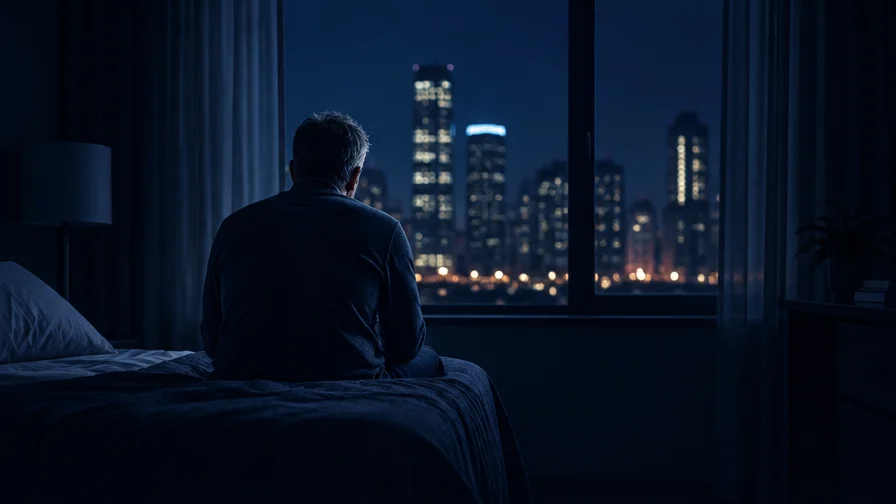
The pattern is familiar enough to be boring. You’re exhausted at four in the afternoon and wide awake at half eleven at night. You go to bed late because the evening is the only part of the day that belongs to you. You lie there with the phone. You sleep badly, wake tired, and repeat it, except at weekends when you sleep until ten and feel worse.
Men in this position tend to describe themselves as bad sleepers, which frames it as a fixed trait. It usually isn’t. Genuine clinical insomnia exists, but it’s much less common than the thing most men actually have, which is a sleep pattern they have dismantled themselves over several years through a small number of entirely reversible decisions.
That’s better news than it sounds. Self-inflicted means fixable.
Fix the wake time first. Everything anchors to it.
If you take one thing from this: stop trying to fix your bedtime. Fix the time you get up.
Bedtime is not really under your control. You cannot decide to be sleepy at half ten — you either are or you aren’t, and lying in the dark willing it to happen tends to make it less likely. Wake time, on the other hand, is entirely under your control, because it’s just an alarm and getting out of bed.
And your body clock takes its cue from the wake time. Get up at the same hour every day and, within roughly a week or two, the sleepiness starts arriving at a consistent hour in the evening on its own. You are not forcing yourself to sleep. You are setting the one fixed point the rest of the system organises itself around.
Including weekends. Especially weekends.
This is where most attempts die, so be clear-eyed about it. If you get up at six on weekdays and ten on Saturday and Sunday, you are giving yourself a four-hour time zone shift twice a week, every week. That is jet lag, self-administered, and it is a substantial part of why Monday morning feels the way it does.
You don’t need military rigidity. Within an hour is fine. Six on weekdays, seven at the weekend — that works. Six and ten does not.
Expect the first week to be genuinely unpleasant. You’ll be getting up at a fixed time while still falling asleep late, which means you will be short on sleep for a few days. That’s the mechanism working, not failing — the tiredness is exactly what pulls your bedtime earlier. Ride out five or six days before you judge it.
Alcohol is doing more damage than you think
Almost every man who drinks in the evening believes it helps him sleep, and in a narrow sense he’s right. It does make you drowsy, and you probably do fall asleep faster.
The problem is what happens after. Alcohol suppresses the deep, restorative portion of the night’s sleep, front-loading a shallow unconsciousness that feels like sleep but doesn’t do the same work. Then, as your body finishes clearing it, you get a rebound in the small hours — awake, warm, heart going slightly too fast, needing the toilet, unable to settle. Three-fifteen in the morning, reliably.
Eight hours in bed. Considerably less than eight hours of useful sleep. This is the single biggest hidden destroyer of sleep quality in men, and it’s hidden precisely because the drink feels like it’s helping.
Two weeks off it on weeknights will tell you more about your sleep than anything else in this article.
The phone
You know this one. It gets included anyway because knowing it hasn’t changed anything.
The problem isn’t mainly the blue light, whatever the settings menu implies. The problem is that the phone is an infinite supply of mildly interesting things, delivered to a tired man with no natural stopping point. Content designed to hold attention is extremely good at holding it. Fifteen minutes becomes seventy. You end up going to bed forty minutes after you meant to, and going to sleep an hour after that, with your mind still moving.
The fix that actually works is physical distance, not willpower. Charge it in another room. Buy a cheap alarm clock. If that’s genuinely impossible, put it across the room where using it means standing up.
Anything that depends on you deciding, at midnight, to stop scrolling will fail, because midnight you is not the man who made the plan.
- Set one fixed wake time and hold it, weekends within an hour.
- Get outside within thirty minutes of waking — light sets the clock.
- Two weeks with no weeknight alcohol, then reassess.
- Charge the phone in another room and buy an alarm clock.
- Awake at 3am for twenty minutes? Get up, low light, dull book.
Morning light does the work you can’t
The fixed wake time gives your body clock a signal. Morning light is what makes that signal loud enough to matter.
Get outside within about half an hour of waking, for ten or fifteen minutes. Walk to get a coffee, stand in the garden, take the longer route to the station. Outdoor light, even on a grey winter morning, is dramatically brighter than anything indoors, and brightness is the variable that counts. A window is better than nothing but is not the same thing.
Do this alongside the fixed wake time and the two together will shift your natural sleep onset earlier far faster than either alone. It is the highest-return ten minutes in the whole routine, and it costs nothing.
What to do at 3am
You’re awake. It’s dark. Your brain has helpfully retrieved a work problem, a conversation from 2019, and an estimate of how many hours remain before the alarm. The estimate is updating every few minutes and getting worse.
The thing that turns a twenty-minute wake-up into a three-hour one is lying there fighting it. Every minute you spend awake in bed teaches your brain that bed is a place where you lie awake, and the arithmetic — if I sleep now I still get four hours — generates exactly the arousal that keeps you up.
So if you’ve been awake for roughly twenty minutes and it’s not happening, get up. Go to another room, keep the lights low, and read something undemanding on paper. No phone, no screen, nothing you have to think about. Stay there until you feel properly sleepy, then go back. It might take twenty minutes. It might take an hour.
This feels like giving up on the night. It isn’t. It’s the difference between one bad night and a bad night that turns into a bad habit, and it’s the single most useful thing to have decided in advance, because you will not reason your way to it at 3am.
When it’s worth asking a doctor
One thing to rule out, briefly. If you snore heavily, or someone has told you that you stop breathing or gasp in your sleep, and you’re sleepy during the day despite spending enough hours in bed, it’s worth raising sleep apnoea with your GP. It’s common, it’s more common in men carrying extra weight, and it’s very treatable — but no amount of wake-time discipline will fix it, so there’s no sense grinding away at the routine for months first. Ask, get it checked, move on.
The order to do this in
Don’t attempt all of it. You’ll last four days.
Week one: fixed wake time and morning light. Nothing else. Accept that the first few days will be rough and let the tiredness do its job of pulling your bedtime backwards.
Week two: add the phone out of the bedroom. By now you’re getting sleepy earlier, so removing the thing that keeps you up is pushing on a door that’s already opening.
Week three: the alcohol experiment. Weeknights only, two weeks.
By the end of a month you’ll have a wake time that holds, an evening that ends at a sane hour, and a fairly precise idea of what was actually wrecking it. Most men find it was two things, not five, and that neither of them was insomnia.